Reddit response about identifying neural anchor points
This page last updated 01/18/2026 (here?)
Takes me a lot of time to understand the material I'm studying. [Finding the better "neural anchor points"]
...Any tips?
-------------------------------------------------------------------------------------
[Me] :As a med-student you should immediately start studying about neuroscience.
To "learn" something new, your neurons have to create "connections' (look up the "connectome"). They have to fire many times in order to wire strongly.
That alone is not enough. As strong as their internal connections may be to each other (to other new neurons within the connectome), the new connectomes have to also connect to some pre-existing anchor points already present in your brain. (Your brain, not mine, not that of the teacher). The trick is to find the appropriate anchor points of our personal brain.
Go to YouTube and search for Dr. Justin Sung. He is a med school graduate who devotes himself to being a "learning coach" who bases his teachings on neuroscience. (There are others as well. Search YT for "learning coaches" to find the others.)
Your post hit home with me today because at the moment I'm an old guy trying to learn the Python programming language, and in particular to wrap my head around a Python construct called a "DataClass". It took me a while to realize that the words used by many of the YT lecturers I was watching were not "sticking" to good anchor points in my personal brain. I'm in the process to identifying better language that will help the concepts stick onto my brain's specific anchor points (see details here, it's a work in progress but includes a reference to the neuroscience of finding the better anchor points).
-------------------------------------------------------------------------------------
[Reader]: Then how to find anchor points? How to make neuron connections faster?
---------------------------------------------------------------------------------------
[Me]: Good question.
Disclaimer: I am not a professional "learning coach". So take my TLDR response below with a grain of salt ... or maybe a truckload of salt.
(1) Each of us has our own personal experiences in real life (IRL). As a result, some words may evoke visceral memories of a certain kind in our brain while other words are mere vanilla or evoke the wrong kind of thoughts.
(2) I can only speak based on my own personal IRL experiences. Hopefully this will nonetheless convey the desired concepts for you.
(3) So in one YT tutorial I watched, the teacher used the word "blueprint" to explain what this thing called a "class" declaration does in the Python programming language. I'm old enough to have had IRL experiences with "blueprints". Mention that word to me and immediately the smell of the mimeograph machine pops up in my brain. The feel of fumbling with large rolls of blueprinted electronic schematics flashes in my mind. Perhaps your IRL experiences cause that word (blueprint) to evoke similar cognitions in your mind, or maybe not. Maybe it means nothing to you, not even a recollection of having read about this ancient technology in a moldy history book.
(4) Although the word "blueprint" did all that in my personal mind, I rejected it as being a good anchor point (a useful metaphor to build more about the concept of "class" upon in my personal brain). That's because for me, a blueprint is not an active machine. Nothing comes out of it. It's just a drawing. And in the case of electrical schematics, it does not even show the actual circuit that will be built, only conceptual symbols for IRL parts.
(5) Another YT lecturer I watched relied on the word "cookie cutter" as a useful analog for the concept of a "class" declaration. I don't do much cooking myself. But I have seen cookie cutters IRL and thus that word also evoked a visceral memory in my mind. I could feel the sharpness of the sheet metal in my head and the smell of the fresh sheet of cookie dough as the cutter is pressed into it. Still I rejected that memory as being a good anchor point for me. It may be perfectly good for other people. Just not for me.
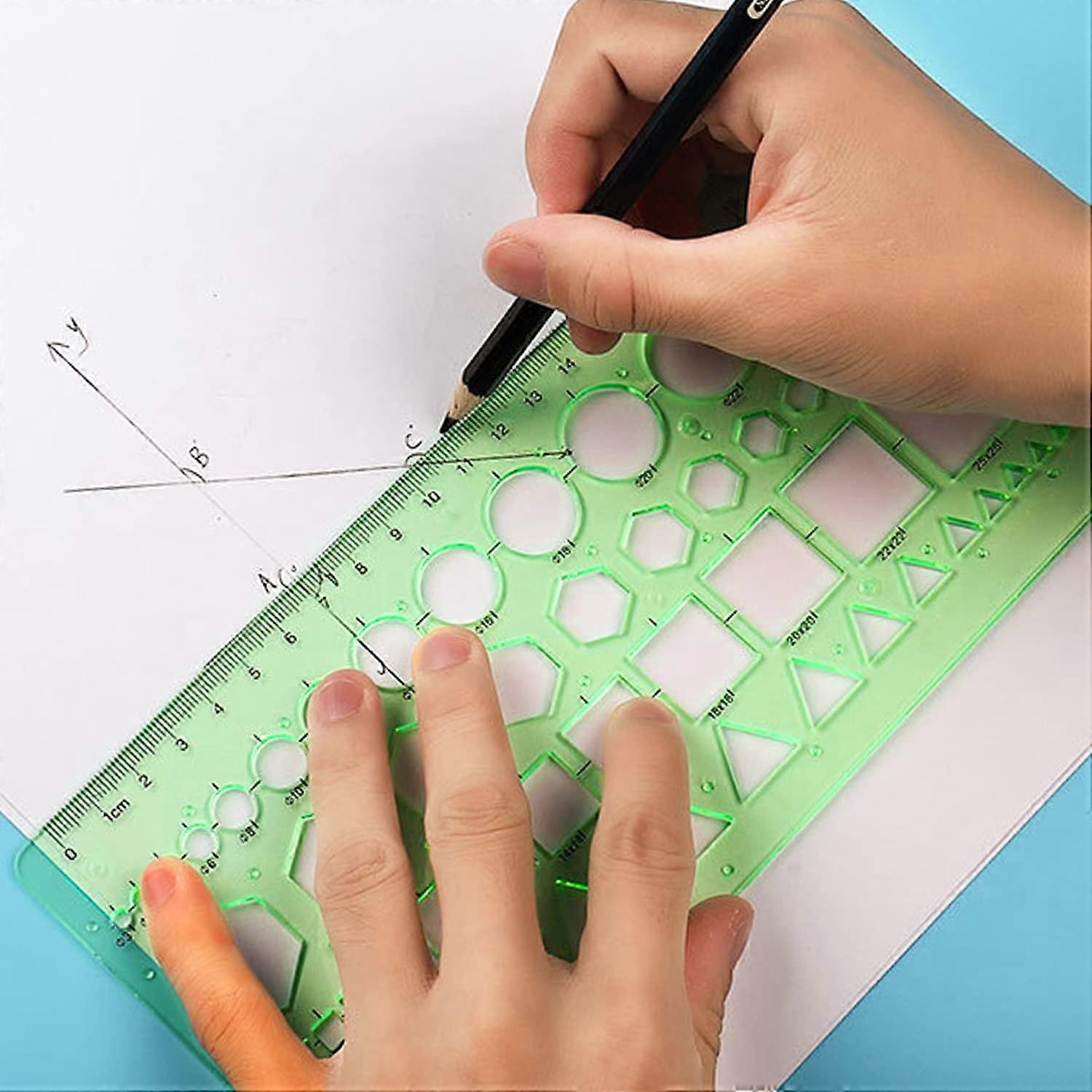
(6) The combination of the words "blueprint" and "cookie cutter" provoked yet another memory in my head based on IRL experiences. It was the memory of using plastic stencils (or "templates") in high school drawing class. A third YT teacher had used the word "template". With that and the memory of stencils, I could recall the feel of my pencil slowly tracing out the stencil outline on my drawing project. I could smell the eraser dust on the paper which kept the stencil from causing smudges on the pencil drawing. It had a machine-like feel to it that produces copies of a same geometric shape over and over and yet, the stencil is not the produced "object", It is a tool for stamping out the instantiated objects (the latter words being additional terms used in object oriented programming or "OOP")
(7) So I picked number (6) as the imagery upon which to build my further understanding of what an OOP "class" declaration is.
(8) You have to step through your own IRL experiences to locate good anchor points (memories) for yourself. The memories are actually neurons from which the new connectomes will grow.
--------------------------------------------------

TO BE CONTINUED:
More thoughts about the above Reddit exchange
There are many detailed aspects of the stencil-as-an-analog choice that I did not address above. I want to now:
(a) The stencil sits at a level above the paper where the produced objects (the drawings) appear. It is in a higher producer level than the produced (instantiated) objects /drawings.
(b) All the produced objects (drawn outlines) share the following attributes / properties:
(b.1) Made by use of the same one stencil;
(b.2) Every produced outline has same size and same shape (e.g. circle, square, rectangle)
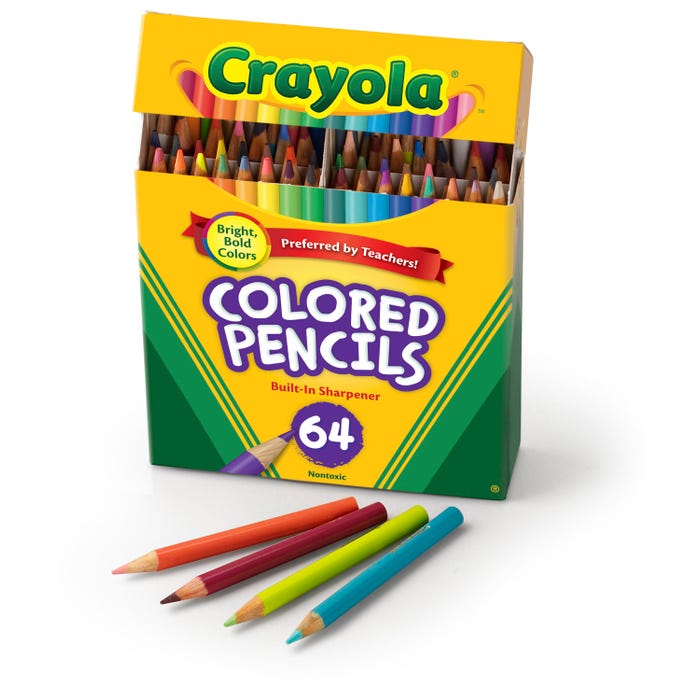
(c) Each of the produced objects (drawn outlines) can have its own unique further attributes. For example by using differently colored pencils, pens, or other outline tracing instrumentalities.
(c.1) It's not merely color, but also: (1) stroke material, (2) stroke width, (3) stroke texture, (4) stroke erasability, (5) vertical depth of the stroke, (6) stroke drying time
(d) Each of the produced objects (drawn outlines) can have its own unique interior filled in by a highlighter, paint film (assuming the stroke forms a vertical rim) or other coloring means.
(e) Each of the produced objects (drawn outlines) can be produced by a chosen use-method (aka function) besides (c) and (d) such as:
(e.1) Selecting the angle at which the stencil is held relative to the underlying paper (or other material on which the outline is inscribed)
(e.2) Each of the produced objects can be located where desired, including immediately adjacent to other stencil-output objects.
(e.3) The user does not have to complete the full outline of the stencil cutout and instead may combine partial traces of different objects
(e.4) The user may elect to erase (or cut with a knife) part of a drawn shape, thus modifying the originally produced object
(e.5) More ????

MORE TO EXPLORE
YouTube search: The stencil as an analog for class production of objects in OOP
---^^^--- String Operators in Python [3 videos]
---^^^--- Analysis of Clocked Sequential Circuits [3 videos]
---^^^--- Introduction to C Programming [20 videos]
---^^^--- Physical Layer and Media (Part 1)
---^^^--- Computer Science Lessons -- Fundamental Concepts of Object Oriented Programming
---^^^--- Class defined as a "template" or "pastry cutter"
---^^^--- Python Programming Step by Step [22 videos]
---^^^--- Latches and Flip-Flops 1 - The SR Latch [stencil symbols for logic gates]
---^^^--- iAmDev -- What is a Class vs What is an Object in Programming? [class as "blueprint"]
---^^^--- What is an interpreter in programming? NOT A COMPILER!
---^^^--- My Visualization Tools (converting simple template shapes into more detailed visuals)
---^^^--- The Mathematical Foundations of Intelligence [Professor Yi Ma] [=Abstracting Reality]
---^^^--- [Categorization=] The "Final Boss" of Deep Learning


Comments
Post a Comment